Inventory and route management
Use live stock and machine status together to guide refill priorities and pre-kitting.
VendingTracker gives operators live fleet visibility so they can spot faults, connectivity problems, and refill priorities before customers discover them first.
Operators buy telemetry to reduce blind spots, catch issues earlier, and keep the fleet manageable as it grows.
Remote fleet monitoring matters because each additional site makes manual oversight more expensive and less reliable.
The value is not abstract data collection. The value is earlier action, faster triage, and a clearer view of which machines need attention now.
Here is the operational view buyers usually want to see once the monitoring story is clear: live machine alerts, fleet state, and a dashboard that supports action rather than passive observation.
The point is not the screenshot on its own. The point is how quickly the team can move from machine signal to service decision.
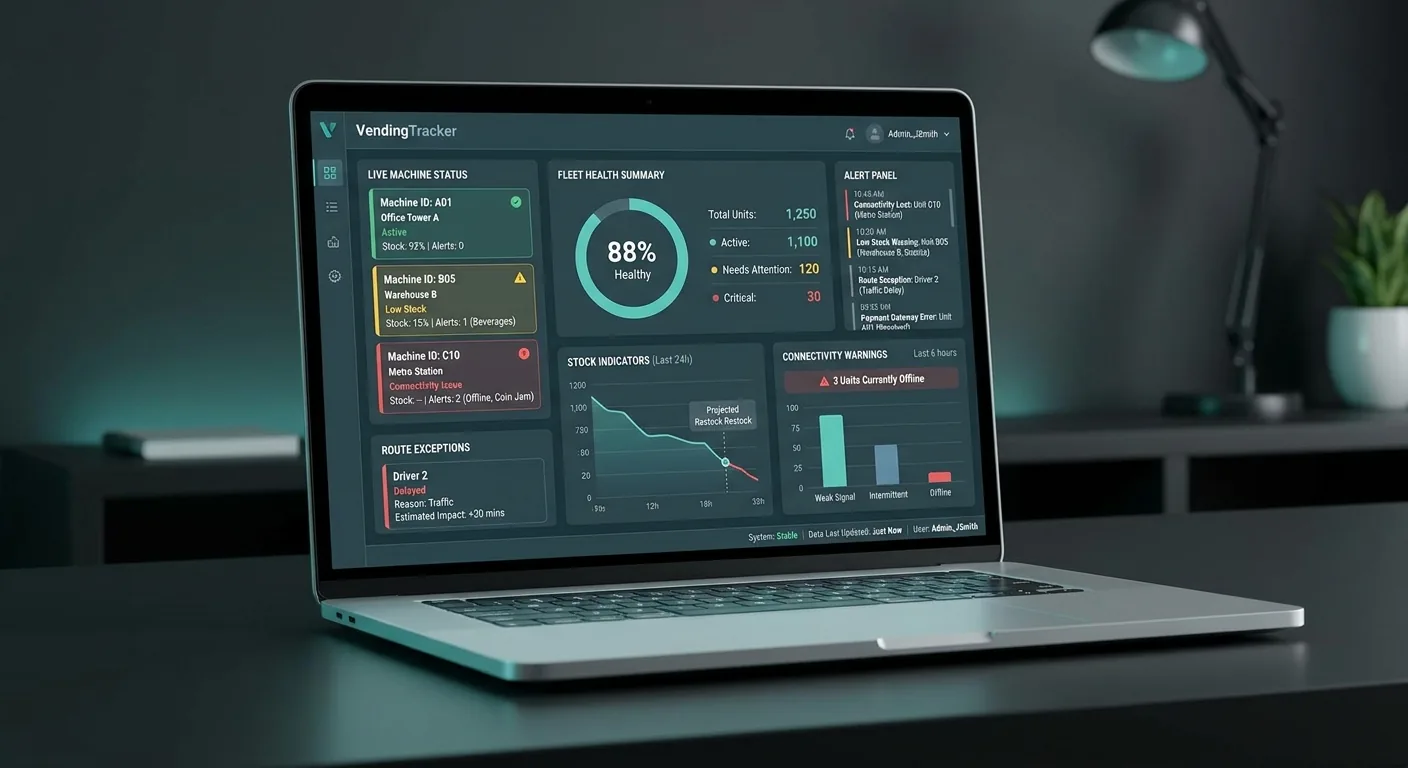
Maintain visibility across locations so your team knows about machine issues before customers do.
VendingTracker ties machine alerts to the inventory and route conversation so the team can move directly from exception visibility into action planning.
Telemetry works best when the next workflow is already in place. That is why this page links directly into vending machine inventory management and vending machine financial reporting rather than pretending monitoring lives in a vacuum.
Ready to see the monitoring layer in action? Book a demo. Need to confirm your machines are compatible first? Start with the compatibility review.
Use live stock and machine status together to guide refill priorities and pre-kitting.
Review machine-level performance with the commercial context needed to understand downtime and service cost impact.
Confirm whether the machine can support the telemetry layer directly or needs a retrofit or integration conversation.
Vending machine telemetry is the real-time collection and transmission of machine status data, including power state, fault conditions, sales activity, and connectivity, from a vending machine to a cloud dashboard.
Operators can review machine status, recent activity, alerts, low-stock signals, and location-level operating context across the fleet in one dashboard.
When the platform detects faults, connectivity issues, or low-stock conditions, those exceptions are surfaced so teams can triage and prioritize them instead of discovering them after a customer experience failure.
Yes. Compatible legacy MDB and Pulse machines upgraded with a DMVI Android IPC can report telemetry into the same cloud environment as supported smart machines.
Telemetry changes route planning by telling the team which machines actually need attention. That reduces unnecessary visits and helps low-stock machines get serviced earlier.
Yes. Machine connectivity and operating signals help operators identify downtime or degraded service earlier than they would through manual inspection alone.
Book a demo, request a compatibility review, or start an integration conversation with the right technical context from the start.